In a world where risk and opportunity coexist across every digital touchpoint, organizations are challenged to find the balance between shielding themselves from harm and seizing emerging advantages. The proliferation of artificial intelligence (AI) has ushered in a new era of exposure management, one that is adaptive, dynamic, and increasingly agentic. This article explores the evolving landscape of exposure management, focusing on how AI-driven agentic exposure management is redefining organizational resilience and opportunity in a rapidly changing environment.
The Shifting Landscape of Exposure Management
Traditional risk management focused primarily on identifying, assessing, and mitigating threats. While this approach remains essential, it is no longer sufficient in an age characterized by real-time information flow, complex interdependencies, and multifaceted digital footprints. Exposure now stretches beyond conventional risks, encompassing everything from cybersecurity vulnerabilities to brand reputation, regulatory compliance, and even unforeseen social or geopolitical developments.
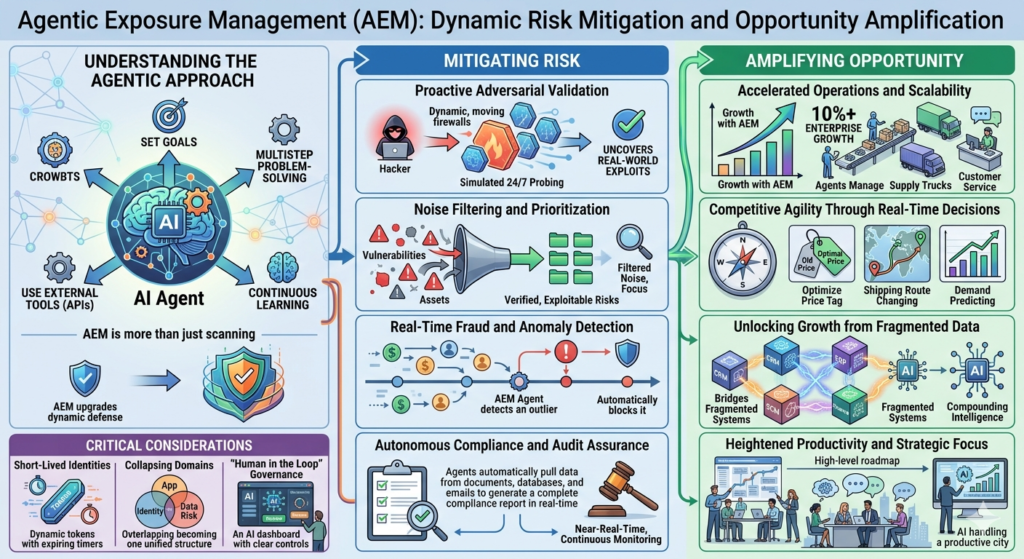
In response, exposure management has evolved into a more comprehensive discipline—one that not only guards against downside but also actively seeks upside potential. This dual mandate requires a more sophisticated approach, blending human judgment with AI-driven tools capable of analyzing vast amounts of data and identifying subtle patterns that humans might miss.
The Rise of Agentic Exposure Management
Agentic exposure management represents a paradigm shift in how organizations navigate the exposure spectrum. Unlike static or rules-based frameworks, agentic systems exhibit a form of autonomy: they continuously sense, interpret, and act on exposure-related information, often in real time. These agentic systems leverage AI to go beyond predefined playbooks, adapting to novel conditions, learning from outcomes, and even collaborating with human counterparts to refine decision-making.
AI-driven agentic exposure management systems excel at integrating diverse data sources—internal and external, structured and unstructured—to create a dynamic, holistic picture of an organization’s exposure. They monitor not only risk factors but also indicators of opportunity, enabling organizations to respond proactively to both threats and emerging advantages.
AI-Driven Approaches: Capabilities and Advantages
The power of AI-driven agentic exposure management lies in its ability to process and interpret data at a scale and speed unattainable by humans alone. For example, consider a global financial institution exposed to shifting regulatory requirements, cyber threats, and volatile market conditions. Traditional manual processes might flag issues after the fact, but an AI-driven agentic system can:
- Automatically scan regulatory updates and assess their impact on compliance postures.
- Detect anomalous network activity that could signal a cyberattack in its earliest stages.
- Identify market anomalies or emerging trends, alerting decision-makers to actionable opportunities.
This capability to sense and act across the full exposure spectrum—simultaneously mitigating risk and amplifying opportunity—is the hallmark of effective agentic exposure management.
Real-World Applications and Practical Examples
Across industries, AI-driven agentic exposure management is proving transformative. In the healthcare sector, for instance, hospitals and health systems must navigate privacy regulations, supply chain disruptions, and shifting patient demographics. By deploying agentic systems that monitor regulatory changes, supplier reliability, and epidemiological trends, healthcare organizations can minimize risk while identifying opportunities to improve patient care or optimize resource allocation.
In the energy sector, companies face exposure to fluctuating commodity prices, environmental regulations, and technological advancements. AI-driven agentic exposure management enables these firms to anticipate regulatory shifts, detect operational anomalies, and capitalize on emerging trends like renewable energy integration—all in real time.
Similarly, in the realm of digital marketing, brands leverage agentic exposure management to monitor social sentiment, influencer activity, and reputational risks. These systems flag potential crises early and uncover opportunities to engage new audiences, adapt campaigns, or protect brand value.
Key Components of AI-Driven Agentic Exposure Management
To understand how AI-driven agentic exposure management delivers both protection and performance, it is important to consider its core components:
1. Data Integration and Contextualization:
Agentic systems aggregate data from a wide array of sources—internal systems, news feeds, social media, regulatory databases, and sensor networks. AI models contextualize this information, discerning what is relevant and mapping it to potential exposure points.
2. Autonomous Monitoring and Detection:
Using machine learning algorithms, these systems continuously scan for anomalies, trends, or signals that might indicate a change in risk or opportunity. This enables early warning and rapid response.
3. Adaptive Response and Human Collaboration:
Agentic systems do not operate in isolation. They engage with human stakeholders, providing recommendations, automating routine responses, and escalating complex issues that require expert intervention. This adaptive interplay ensures that decisions are well-informed and agile.
4. Continuous Learning and Improvement:
AI-driven agentic exposure management platforms are designed to learn from outcomes. By analyzing the effectiveness of past interventions, they refine their models and recommendations, becoming more accurate and responsive over time.
Mitigating Risk: Proactive, Not Reactive
One of the most significant benefits of agentic exposure management is its capacity for proactive risk mitigation. Rather than waiting for issues to materialize, organizations can anticipate threats and take action before they escalate. For example, in cybersecurity, agentic systems can identify suspicious activity patterns before a breach occurs, allowing defenses to be strengthened preemptively.
Similarly, in supply chain management, AI-driven exposure management platforms can detect early signs of disruption—such as geopolitical developments, supplier financial instability, or natural disasters—and recommend contingency plans. This approach minimizes operational downtime and financial loss.
Amplifying Opportunity: Turning Data into Advantage
While much attention is often paid to risk, exposure management is equally about seizing opportunity. AI-driven agentic exposure management uncovers patterns and correlations that might otherwise go unnoticed, enabling organizations to act swiftly on emerging trends.
For instance, in retail, agentic systems analyze consumer behavior, competitor activity, and market sentiment to reveal new product opportunities or untapped market segments. In finance, these systems identify arbitrage possibilities, shifting investment climates, or cross-border expansion opportunities—all in real time and with a level of precision that manual analysis cannot match.
Overcoming Challenges and Building Trust
Despite its promise, the adoption of AI-driven agentic exposure management is not without challenges. Data quality, model transparency, and ethical considerations must all be addressed to ensure trustworthy outcomes. Organizations must establish robust data governance policies, ensure that AI decisions are explainable, and maintain human oversight to guard against bias or unintended consequences.
Furthermore, building trust in agentic systems requires a commitment to transparency and accountability. Stakeholders must understand how decisions are made, what data is used, and how systems learn and evolve. This transparency not only satisfies regulatory requirements but also fosters confidence among users, partners, and customers.
The Future of Exposure Management: Toward Autonomous Organizations
As AI capabilities continue to advance, the vision of fully autonomous exposure management comes into sharper focus. In this future, agentic systems will not only augment human decision-making but may also take on increasing levels of responsibility for managing exposure across entire enterprises. This shift will demand new models of governance, collaboration, and ethical oversight.
However, the core principles will remain unchanged: the need to balance risk and opportunity, to act swiftly and intelligently, and to build systems that are both resilient and adaptive. Organizations that invest in AI-driven agentic exposure management today are positioning themselves to thrive in tomorrow’s complex, interconnected world.
Conclusion
The evolution of exposure management is being shaped by the convergence of AI and agentic systems, enabling organizations to move beyond reactive risk avoidance and toward a proactive, opportunity-oriented approach. By harnessing the power of AI-driven agentic exposure management, businesses can not only mitigate risk but also amplify their capacity for growth and innovation. As the exposure spectrum continues to widen, those who lead in adopting these technologies will be best equipped to navigate uncertainty and realize sustained success.