
How do we see the world around us? Today, we understand that our eyes receive light that bounces off objects. But for centuries, some of the greatest minds in history believed the exact opposite. They thought our eyes sent out invisible rays to “touch” the world, a concept known as the emission theory of vision. This idea, though incorrect, was a critical step in our journey to understanding sight.
This article will explore the fascinating history of the emission theory. We’ll cover what it was, who proposed it, and why it was eventually replaced by our modern understanding of vision. By looking back at these early ideas, we can appreciate how scientific knowledge evolves over time.
What Is the Emission Theory of Vision?
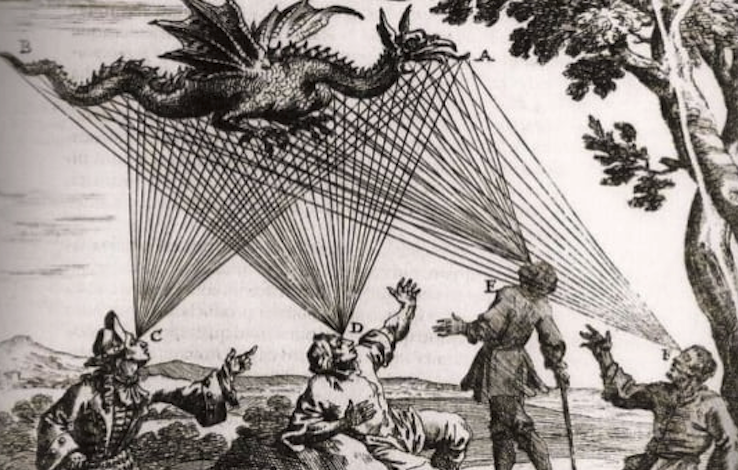
The emission theory of vision, also known as the extramission theory, proposed that vision occurs because our eyes emit rays of energy. Think of it like a pair of invisible, super-fast tentacles reaching out from your pupils. According to this theory, when these rays hit an object, they would gather information about its shape, color, and location, and then return that information to the brain, allowing us to see.
In this model, the eyes are active projectors, not passive receivers. They were seen as the source of a special “visual fire” or “pneuma” that made sight possible. It was a simple and intuitive explanation that seemed to answer some basic questions about how we perceive our surroundings.
Historical Background of Emission Theory
The roots of the emission theory lie in ancient Greek philosophy. Thinkers of that era were deeply curious about the natural world and tried to explain its mysteries through logic and observation. One of the earliest and most influential proponents of this theory was the philosopher Plato. He suggested that a gentle fire emanated from the eyes, which combined with daylight to form a single body of light connecting the eye to the object being viewed.
Another key figure was the mathematician Euclid. He approached vision from a geometric perspective. In his work Optica, he described visual rays as straight lines traveling from the eye. While he didn’t focus on the physical nature of these rays, his geometric model reinforced the idea that something traveled from the eye to the object, not the other way around. This early scientific thinking laid the groundwork for centuries of debate about the nature of sight.
How Does the Emission Theory of Vision Work?
To understand how ancient thinkers imagined the emission theory working, let’s break it down into a step-by-step process.
- Emanation of Rays: The process begins inside the eye, which was thought to contain an inner fire or light. This visual fire produces fine, fast-moving rays that are projected outward through the pupil.
- Interaction with Objects: These rays travel in straight lines until they encounter an object. Imagine them sweeping across your field of view like a searchlight. When a ray touches an object, it essentially “feels” its surface.
- Information Gathering: The ray instantly gathers data about the object’s properties—its form, texture, and color. The theory suggested that the ray could somehow sense these qualities upon contact.
- Returning to the Eye: The information is then transmitted back along the ray to the eye and, subsequently, to the soul or mind, where the perception of the object is formed.
For example, when looking at a tree, your eyes would send out a cone of rays. The rays that hit the trunk would register its brown, rough texture, while those hitting the leaves would register their green color and shape. This constant stream of information-gathering rays would create a complete mental picture of the tree.
Key Assumptions of the Emission Theory
The emission theory was built on a few core assumptions that seemed logical at the time:
- Eyes Actively Emit Light: The central and most important assumption was that the eyes are the source of vision, actively sending out some form of energy or light. This put the power of sight squarely within the individual.
- Limited Role of External Light: While thinkers like Plato acknowledged that daylight was necessary for vision, they didn’t see it as the primary medium. Instead, they believed external light merged with the eye’s internal rays to make sight possible. The eye’s fire was the essential ingredient.
- Importance of a Direct Line of Sight: Euclid’s geometric model emphasized that you can only see things that are in a direct, unobstructed line from your eyes. This made perfect sense with the idea of rays traveling in straight lines. If an object blocked the path, the rays couldn’t reach what was behind it.
Examples Used to Support Emission Theory
Ancient philosophers used everyday observations to support their ideas. While these interpretations were later proven wrong, they show how people tried to make sense of the world with the knowledge they had.
- Seeing in the Dark: Proponents argued that the reason we can’t see in complete darkness is that our eye’s fire, while powerful, needs the aid of ambient light (like daylight) to travel far and perceive objects clearly.
- The Sensation of Eye Contact: The powerful feeling of making eye contact with someone was sometimes used as evidence. It felt as if something was being exchanged or sent between the two individuals, which aligned with the idea of eye-beams.
- Reflections in Mirrors: When looking into someone’s eyes, you can see a tiny reflection of yourself. Some interpreted this as evidence of the eye’s inner fire or light being visible.
Limitations of the Emission Theory of Vision
Despite its long-standing popularity, the emission theory had significant flaws that became more apparent as scientific inquiry advanced.
- The Darkness Problem: The biggest challenge to the theory was a simple question: If our eyes produce their own light, why can’t we see in total darkness? The explanations offered were often convoluted and unconvincing. If the eye’s fire was real, it should be able to illuminate a dark room on its own.
- The Energy Problem: Why doesn’t looking at something for a long time tire our eyes out from constantly emitting energy? And how could our eyes possibly emit enough energy to see distant stars, which are light-years away, almost instantaneously?
- Lack of Physical Evidence: No one could ever detect or measure the supposed rays coming from the eyes. As the principles of scientific experimentation grew, the lack of empirical evidence made the theory increasingly difficult to defend.
Emission Theory vs. Intromission Theory
The primary rival to the emission theory was the intromission theory, which argued for the process we now know to be true.
Emission Theory
- Core Idea: Vision occurs when rays are emitted from the eyes and strike objects.
- Strengths: It explained the directness of gaze and offered an intuitive, active role for the observer.
- Weaknesses: It couldn’t properly explain why we need external light to see, nor could it account for the energy required to see distant objects.
Intromission Theory
- Core Idea: Vision occurs when light from an external source (like the sun) reflects off objects and enters the eye.
- Aristotle’s View: The philosopher Aristotle was a notable supporter of an early form of intromission. He argued that objects impress a copy of their form onto the air, which then travels to the eye.
- Modern Relevance: This is the direct predecessor to our modern understanding of vision. The core concept—that light enters the eyes—is correct.
Why Was Emission Theory Rejected?
The shift away from the emission theory was a gradual process driven by the scientific method. The most pivotal figure in its downfall was the 11th-century Arab scholar Ibn al-Haytham (known as Alhazen in the West).
Considered the father of modern optics, Ibn al-Haytham used rigorous experiments to test the prevailing theories of vision. He demonstrated that light travels in straight lines and showed that vision happens when light reflects off an object and enters the eye. In one famous experiment, he showed that a bright light could damage the eye, arguing that this wouldn’t happen if the eye were emitting rays rather than receiving them. His work, Book of Optics, systematically dismantled the emission theory with evidence-based arguments and laid a new, solid foundation for understanding vision.
Modern Scientific Explanation of Vision
Our current understanding of vision is a refined version of the intromission theory, backed by centuries of research.
- Light Reflection: A light source, like the sun or a lamp, illuminates our environment. Light rays strike objects and bounce off them in all directions.
- Entering the Eye: Some of these reflected light rays enter our eyes through the cornea and pupil, where the lens focuses them onto the retina at the back of the eye.
- Retina and Optic Nerve: The retina is filled with millions of light-sensitive cells called rods and cones. When light hits these cells, they convert it into electrical signals.
- Brain Processing: These electrical signals travel along the optic nerve to the brain. The brain then processes these signals and interprets them, creating the images we perceive.
In short, our eyes are sophisticated light detectors, not projectors.
Importance of Emission Theory in Science History
Though scientifically incorrect, the emission theory of vision holds a significant place in history. It represents one of humanity’s first major attempts to explain a fundamental biological process. The debates between emission and intromission theorists spurred critical thinking and encouraged observation and logical reasoning.
The eventual rejection of the theory in favor of an evidence-based model marks a crucial moment in the evolution of the scientific method. It showcases science as a process of trial and error, where old ideas are tested and replaced by better ones. Without these early theories to challenge and improve upon, the development of modern optics would have taken a very different path.
Common Misconceptions About Emission Theory
- Myth of a “Real” Power: The theory was a philosophical and early scientific model, not a belief in a literal superpower. Thinkers were trying to explain a natural phenomenon with the tools they had.
- Night Vision Confusion: The “cat’s eyes” glowing in the dark was sometimes used as an example, but this is due to a reflective layer in their eyes (the tapetum lucidum), not because they are emitting light.
- Ancient vs. Modern Science: It’s easy to dismiss ancient ideas as silly, but they were logical conclusions based on the available evidence and philosophical frameworks of the time.
FAQs
Who proposed the emission theory of vision?
The theory was championed by several ancient Greek thinkers, most notably the philosopher Plato and the mathematician Euclid. Their ideas dominated scientific thought on vision for over a thousand years.
Is emission theory scientifically correct?
No, the emission theory of vision is not scientifically correct. Modern science has overwhelmingly proven that vision works through intromission—light entering the eye—not extramission.
Why did ancient scientists believe this theory?
They believed it because it seemed to explain certain observations intuitively, such as the directness of gaze and the feeling of making eye contact. It was a logical model based on observation before the tools for detailed experimentation existed.
What theory replaced emission theory?
The emission theory was replaced by the intromission theory, which states that light from external sources reflects off objects and enters the eye. The work of the scholar Ibn al-Haytham in the 11th century was instrumental in proving this.
Conclusion
The emission theory of vision is a powerful reminder that science is a journey, not a destination. For centuries, it was the most accepted explanation for how we see, supported by some of history’s greatest intellects. Its eventual replacement by the intromission theory through rigorous experimentation highlights the triumph of the scientific method.
By studying these outdated ideas, we learn more than just history; we learn how knowledge is built, challenged, and refined. The story of the emission theory is not one of failure, but of a crucial stepping stone that ultimately led us to a clearer vision of the world.
Refrence: https://en.wikipedia.org/wiki/Emission_theory_(vision)